Saturday, February 4, 2012

My Survival Pack

          Many people attempt to make the quintessential survival pack.  The quest is never ending for a pack that includes an implement for every event that may arise.  My approach is to carry a few items that are going to have the biggest impact while lost or bored on the trail.
I usually carry a small fixed blade or more often my Swiss Army knife.  Also pictured is a magnifying glass multi-use key chain.
          First and foremost, you need a good pocket knife.  Yes, I am aware of how treacherous of a topic it is as to which knife to carry.  Lets not go there; simply, I always carry a small blade such as a Swiss army knife. This knife is used for small chores such as sharpening sticks, cutting cord, and generating sparks with a flint or fire steel.  A larger knife has it's advantages and should not be left off the list if you are preparing for extended trail stay.  Once again, you want to always be prepared, so a smaller pocket knife is easier to keep with you at all times.
         Carrying a lighter or matches at all times is handy, but water and cold temperatures can effect whether these items make fire.  A good alternative, is a small magnifying glass or fire steel.  Both of these have the advantage of being small enough to attach to a set of keys and will also work under wet or cold temperatures. 
          Lastly, I carry a "last ditch" container that is waterproof and contains matches, a length of fishing line, and two dry flies.  The container is small pill bottle that goes on your key ring and I bought it at Wal-mart for two dollars.  The dry flies are included just in case no bait is available.  Otherwise bait could be attached to the hooks.  The fishing line is 6 lb test tippet, used in making leaders for trout fishing.  A tippet has the advantage of being more invisible than most regular fishing lines.
        My idea is to carry items that are kept with me at all times and would be useful if needed.  Of course there are many variations and mine is simply one variation of a useful survival pack.  After writing all this, I realize it would be more appropriate to call the article survival pocket gear.  Either way, small, useful, and easy to carry is the take home message.

Disclaimer:  The above information is simply the authors opinion and should not be viewed as fully inclusive for survival skills.  Always seek professional advice or training when preparing for surviving any environment.  The author is not a professional source and assumes no responsibility.

Sunday, January 29, 2012

Camping with Canines: A How to guide.

      It is a rewarding experience to be able to bring your dog camping with you.  After all, nothing beats having your favorite sidekick sitting with you in the warm glow of the camp fire or gracefully blazing the trail with you.  But there are some considerations and preparations that help make this experience a natural, harmonious endeavour.
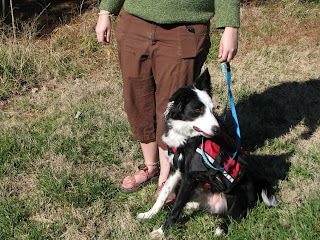
      First, consider who your dog is.  Think about how he interacts with people, such as meeting strangers on the trail and walking by groups of people.  Give consideration to health problems or limitations that your dog may have.  For example, older dogs may have hip problems or smaller dogs may have difficulties in keeping your pace.  If you are going to be strapping a pack onto your dog, do not overload and provide ample water to drink. For example, my dog carries a bottle of water, small plastic bag of food, a few treats that are high in fat and protein, and a portable water/food bowl. For toys, he finds sticks to play with along the way.
      Dogs are constantly being bombarded by smells and sounds that could attract them, so do not let them out of your sight.  There's nothing worse than having your best friend return to camp smelling of dead opossum.  Make sure that your dog does not ingest anything it is not supposed to.  Mushrooms are the first thing that comes to mind, but food scraps are probably more common as a means to making your dog sick.  When your dog has to make a waste deposit be watchful and clean up the mess.  Nothing worse than stepping in a smelly mess on the trail.  Apart of keeping watch over your dog is making sure they are leashed where required.
       Leashing your dog ensures his safety and you a level of control over his actions.  Some people may not want to be greeted with two muddy paws.  Leashing also ensures the safety of others in the area.  Horses are usually an uncommon site that sends most dogs into frenzies.  If your dog spooks the horse and it reciprocates by throwing its rider, you're in a bad spot.  Leashing keeps you and your dog in a good range for communication.  It is nice to be able to give commands when needed, but also casual conversation will more likely occur.
      Double check your resources and itinerary to make sure accommodations are made for your dog.  Decide before heading out, whether your dog will sleep in the tent, what to do if it rains, and how to accommodate him being with you at all times..  Nobody wants to hear a dog left at the campsite barking, crying all day; it creates stress for everyone and is not fair for the dog.
        Having your dog at camp is real treat for both you, him, and others you may pass.  Follow the above guidelines and you can't go wrong with camping out with canines.


Thursday, January 26, 2012

Horace Kephart: The Original Carolina Adventurer

 
 Photo Credit:  http://barkriverknives.com/albums/album369/Horace_Kephart.jpg
    
      Horace Kephart was not only a master outdoorsman and accomplished writer, but more importantly he was an advocate for environmental policy.  Kephart utilized his literary background and love of the mountains to persuade leaders of the early 1900s to create the Great Smoky Mountains National Park.  Kephart's obsession with mountain places, people, and wildlife culminated in his writing, and gave a voice to all who lived in the Great Smoky Mountains.  It was a combination of Kephart's writing and his friend George Masa's photography that helped create the Great Smoky Mountains National Park.
      Horace Kephart serves as a example of what passion and drive can accomplish.  Before moving to the mountains of North Carolina, Kephart demonstrated a high level of ambition through his work as a librarian.  He was appointed of head librarian at the St. Louis Mercantile Library, after gaining experience in library work at Cornell and Yale.  Looking for a new start on life, Kephart left his library position and headed for the mountains.  He now lived in an area that he was passionate about and had ample subject matter to write about, so he supported himself through writing for outdoor magazines.  Kephart's love for the mountains continued to grow as he now began writing letters and brochures expressing the need to preserve such a beautiful place.  He described the Great Smoky Mountains as "one of the finest primeval forests in the world".
             There exists an innate goodness that nature possesses and Horace Kephart saw this.  During the early 1900s, forests existed for the sole purpose to be cut down; forests were viewed by amount of timber they would produce.  This form of destruction Kephart viewed as wasteful and envisioned better way to use the land.  He brought his vision before others and with the help of his friend George Masa, put forth a very compelling reason for the forest.  This ultimately saved the land and created the Great Smokies National Park.
      Horace Kephart was a visionary outdoorsman that preserved a gem for future generations.  He was a very intelligent, educated man that felt passionately about the outdoors.  My wish is that, like Horace Kephart, we use the power of one to move mountains.

Tuesday, January 24, 2012

My Restlessness

      As Spring draws closer my restlessness becomes incessant and heightened.  I enjoy the winter up through the New Year and then I feel the urgency to get outside.  January and February are the most uncomfortable for me.  These are the two months that are generally cold and spent planning for warmer weather.
      All the romantic notions associated with camping, I find myself daydreaming of during these months.  I think about camping in vibrant neon green forests, life renewed, refreshed after the long cold winter.  I see myself siting by a camp fire in a field where at dusk, fireflies began to waft gently towards the lumbering leaf clusters above.  Embers glowing hot and red like tiny suns sublimely settled in a bed of gray.  I hear the laughter of the children in the tent and glance towards the stars.  I am reminded of how all of God's creations are wonderful and unending.  I am lying in the tent listening to the complex chorus of night.  My body feels heavy, I smell the sweet aroma of the camp fire dying down just as my mind does the same.
       My restlessness still builds through March but at least with warmer days I can assuage it with short adventures locally.  March is spent visiting local parks where the children play and the sun gently tests warmer rays.  I often search out rivers and lakes.  I have increased interest in water.  I cast gently out into the river bend.  A large fish silhouette approaches the site where my bait dangles.  A quick nibble and then my pole is bent.  I wrestle with the 2 pound cat fish like I'm reeling in a man-eating Alligator Gar.
    By the time April arrives the worst is over.  The restlessness breaks way as warmer temperatures become the norm.  I go hiking through the forest with neon green in full show.  The creeks and rivers look inviting with the chill of winter now in the past.  I find the perfect campsite, off the trail, beside a small stream.  The ground is still moist from a rain the previous night.  Perhaps I will be lucky enough to be lulled asleep by a gentle nocturnal rain shower.  The campfire provides a beautiful glow and billows the new leaves in the warm night air.
        May brings the relief I have been looking for. Warmer days have become the norm and the forbidden pleasure of swimming is no longer taboo.  I walk down the sidewalk littered with pollen from the pine trees.  Today the pool has opened  and swimming is on the menu.  The restlessness is now an entire season away.  My body feels more alive and I feel carefree.

Tuesday, January 17, 2012

Good Trail Eats on the Cheap

      When it comes to camp food, I have noticed lighter foods are more expensive and heavier foods can be had more cheaply.  For example, a Backparcker's freeze dried entree is usually priced around $8, while a hefty can of generic pork and beans is priced at $1.50.  I have found some great dehydrated soups that are priced around $3.  The soups are priced cheaply and they taste great as well.
       The soups are made by Bear Creek Country Kitchens.  There are various potato, chicken, and bean recipes that cook up in about 10-15 min.  I recently tried the chicken noodle and it was de-li-cious.
       My idea is the next time I go camping buy a pack and transfer what I need to a zip lock bag and save the rest for later.  A simple way to do this is add the contents to a bowl and mix first (all the noodles, potatoes, etc tend to settle in the bottom of the packaging).  Next, measure a dry serving size (usually 1/4-1/3 cup) into a zip lock bag.  When on the trail simply add this to one cup of boiling water, simmer, and viola, hot trail eats on the cheap.  This method will make 8 single servings per three dollar pack of soup.

Monday, January 16, 2012

North Carolina Museum of Natural Sciences

There are so many cool exhibits at the Natural Sciences Museum, below are just a few to showcase.  The museum is located in downtown Raleigh, NC.

Sunday, January 15, 2012

If I were a Troll Hunter, What Would I Drive?

                                                                                                                                                                                               I recently watched the movie Troll Hunter and have become obsessed with designing my ultimate troll hunting rig.  If you haven't seen the movie, it's a subtitled Norwegian film that is available on Netflix.  The movie is shot as a documentary filmed by four college students who follow a guy that hunts real live trolls.  The troll hunter drives a Land Rover Defender that is out rigged with all the necessary troll hunting equipment.                                                                         Some men have fantasy football, while I have dreams about troll hunting and driving a cool rig like the troll hunter in the movie.  The question is what type of rig would I drive and how would I have it set up.  There are many choices that come to mind, Land Rover being one of them, but not my final decision.  Lets assume I'm an American troll hunter.
     Being an American troll hunter makes me envision a huge lifted Ford or Chevy equipped with an external roll cage that has metal spikes welded to it as troll deterrent.  It might not be very practical to expect a F-250 to weave about while being trailed by a temperamental troll.  Get up and go or pedal to the metal response would make me feel a little safer.
      You would want the capacity to carry 3 passengers in the event you meet a film crew that is willing to offer a large sum of money for some troll hunting footage(the bigger the fantasy, the better).  I would vote on a quad cab truck.  The Bed would hold mountable/dis-mountable UV lights and other equipment.
      A truck will have a lower center of gravity as opposed to an SUV with roof mounted equipment.  Trolls probably are not gold medalists in distance running, but they look quick and fast over short distances.  With this in mind, I would choose a V-8 engine with lots of horsepower over one that is a fuel miser.  And of course I would outfit the Truck with a 6 inch lift and include large mud tires such as Swamper TSLs.  I'm not sure I would attach an external roll cage, unless needed for a particular job.  The roll cage seems like adding a handle with a sign that says: "Troll grab here and totally trash my truck".
       Up to this point in the blog I haven't eluded to, other than it's a truck, what type of troll hunter truck I would drive.  Drum roll please.  I believe I would go with a base model Toyota Tundra.  I know its not anything grand, but I believe it would be the most plausible troll hunting rig.  What type of troll hunting rig would you drive?